

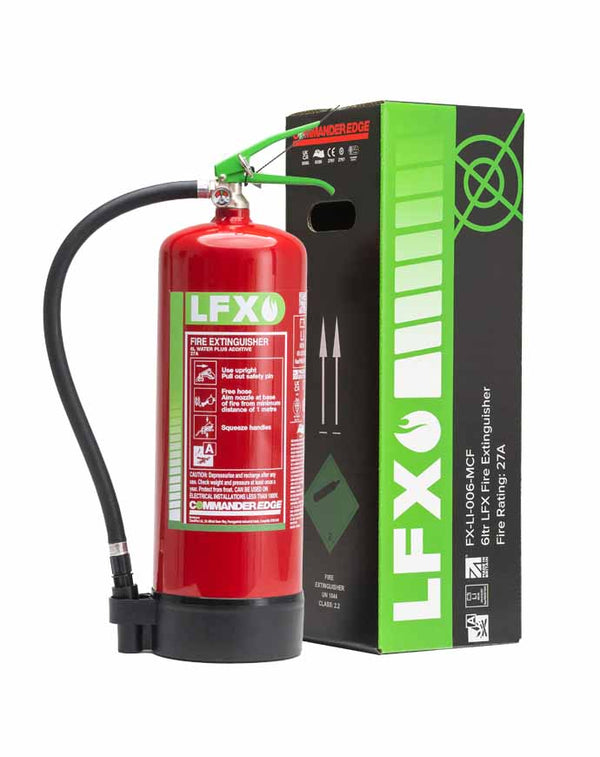

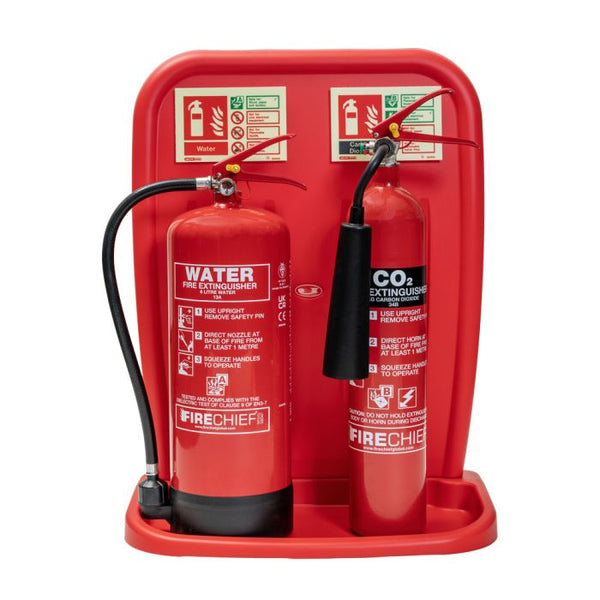
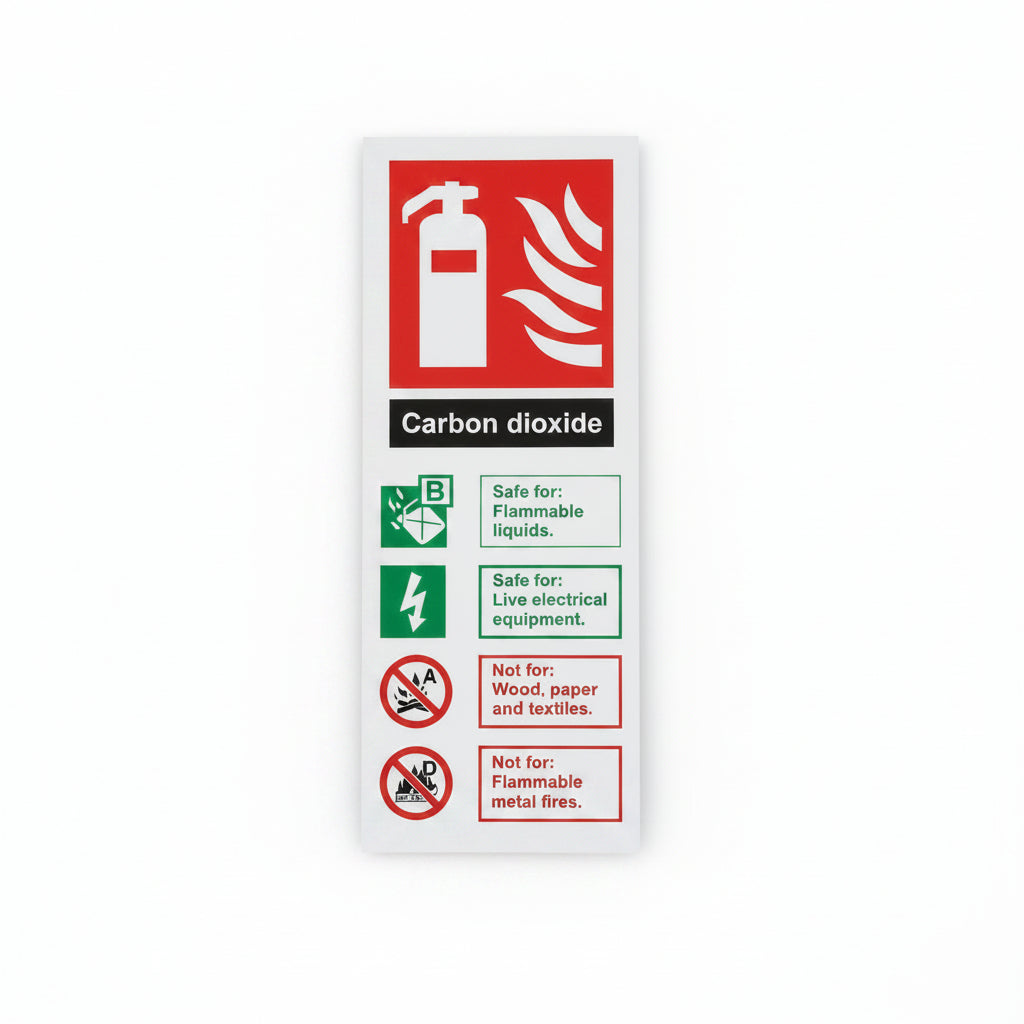
Fire extinguisher signs do two jobs. Location signs show people where fire-fighting equipment is, using the white-on-red "fire extinguisher" symbol (ISO 7010 F001). Identification signs, fixed above or beside each extinguisher, show what type it is and which fires it can and cannot be used on. Under the Health and Safety (Safety Signs and Signals) Regulations 1996, fire-fighting equipment must be identified with signs where needed. This guide explains which signs you need, where to put them, and how to choose between standard and photoluminescent versions.
Why fire extinguisher signs matter
In a fire, people need to find the right extinguisher quickly and use it on the right fire. Using the wrong type can make things worse: water on burning cooking oil or on live electrical equipment, for example. Clear signage tells people where the equipment is and helps them pick the correct extinguisher in seconds.
What the law and standards say
- The Health and Safety (Safety Signs and Signals) Regulations 1996 require employers to provide safety signs where a risk cannot be avoided or adequately reduced in other ways, and they set the format for fire-fighting equipment signs: a white symbol on a red rectangular or square background.
- BS EN ISO 7010 sets out the registered safety symbols used on UK signs. Relevant fire equipment symbols include F001 (fire extinguisher), F004 (collection of fire-fighting equipment, often called a fire point) and F005 (fire alarm call point).
- Your fire risk assessment, required under the Regulatory Reform (Fire Safety) Order 2005 in England and Wales and equivalent legislation in Scotland and Northern Ireland, should confirm where extinguishers and signs are needed.
Types of fire extinguisher sign
Location signs
Location signs show where an extinguisher or fire point is, particularly where the equipment cannot be seen from the approach, such as around a corner or behind a door. Examples include the Firechief fire extinguisher location sign (6490DD/R) and the Firechief fire point location sign (6459DD/R).
Identification (ID) signs
ID signs sit above or beside each extinguisher and show its type and the classes of fire it is suitable or unsuitable for. They normally use the same colour band as the extinguisher's label, following the UK colour coding recommended in BS 7863:
| Extinguisher | Colour band | Example sign |
|---|---|---|
| Water | Red | Firechief WATER photoluminescent sign |
| Foam | Cream | Foam ID sign, photoluminescent self-adhesive |
| Dry powder | Blue | Firechief ABC POWDER photoluminescent sign |
| CO2 | Black | CO2 ID sign, photoluminescent self-adhesive |
| Wet chemical | Yellow | Firechief WET CHEMICAL photoluminescent sign |
For more on what each colour and type means, see our fire extinguisher colours and types guide.
Where to put fire extinguisher signs
- Fix the ID sign directly above or beside the extinguisher it describes, so the sign stays visible even when the extinguisher has been removed.
- Where several extinguishers are grouped at a fire point, use a fire point sign together with an ID sign for each extinguisher.
- Use location signs where the equipment is not visible from the main route, so people can follow them to it.
- Keep signs clear of obstructions, at a height where they can be seen over furniture and people.
- Make sure the sign matches the extinguisher. If an extinguisher is replaced with a different type, change the sign too.
Photoluminescent or standard signs?
- Photoluminescent signs absorb ambient light and glow for a period afterwards, so they remain visible in low light or if the lighting fails. They suit corridors, stairwells, plant rooms and any area that could become dark.
- Standard (non-glow) signs in rigid plastic or self-adhesive vinyl suit well-lit areas.
- Brushed aluminium or stainless finishes are available for offices, hotels and reception areas where appearance matters.
Choose rigid plastic for screw or adhesive fixing to walls, and self-adhesive vinyl for smooth surfaces. Browse the full range of fire safety signs.
Frequently asked questions
Is it a legal requirement to have fire extinguisher signs?
Employers must provide safety signs where the risk assessment shows they are needed, and fire-fighting equipment must be identifiable. In most workplaces this means ID signs at every extinguisher and location signs where equipment is out of sight.
What colour are fire extinguisher signs?
Fire equipment signs use a white symbol on a red background. ID signs also carry the colour band of the extinguisher type.
What height should a fire extinguisher sign be?
There is no single fixed height in the regulations. Mount ID signs above or beside the extinguisher and location signs where they can be seen clearly from the approach.
Do I need a sign for a fire blanket?
Yes, it is good practice to mark fire blankets with a fire blanket ID sign so people can find them quickly.
Are photoluminescent signs better?
They stay visible in low light or a power failure, which is useful along escape routes and in dark areas. In well-lit rooms, standard signs are fine.
This guide is general information. Follow your fire risk assessment and the advice of a competent fire safety professional.