


A fire blanket is a sheet of fire-resistant cloth, usually woven glass fibre, that smothers a small fire by cutting off its oxygen. It is mainly used for small cooking pan fires and for wrapping a person whose clothing has caught fire. In the UK, fire blankets should be certified to BS EN 1869, which covers sizes from 1.0 x 1.0 m to 1.8 x 1.8 m. This guide explains which size to buy, where to mount it, how to use a fire blanket safely and when a fire blanket is not the right tool.
What is a fire blanket for?
Fire blankets are designed for two main jobs:
- Small cooking fires, such as a pan of oil or fat on a hob, where water would make the fire much worse.
- Clothing fires, where the blanket is wrapped around a person to smother the flames.
They are common in domestic kitchens, staff kitchens, schools, laboratories, caravans, workshops and offices. A fire blanket needs no training to deploy, does not make a mess and never needs refilling, which makes it a useful addition to the fire extinguishers on site. For a reminder of which fires are which, see our guide to classes of fire.
BS EN 1869 and fire blanket sizes
BS EN 1869 is the standard for fire blankets. Check that the blanket you buy is certified to it, ideally with third-party certification such as a Kitemark. The standard sizes are:
| Size | Typical use |
|---|---|
| 1.0 x 1.0 m | Domestic kitchens, caravans and boats, small staff kitchens |
| 1.2 x 1.2 m | The most popular size for homes, offices, schools and commercial kitchens |
| 1.2 x 1.8 m | Larger kitchens, laboratories and workshops, and wrapping a person |
| 1.8 x 1.8 m | Industrial and commercial settings, and wrapping a person |
A larger blanket gives the user more protection for their hands and covers a wider pan or a person more easily, but it must still be light and quick enough for anyone on site to use.
Soft case or rigid case?
- Soft cases are light and simple. The Firechief SVB2/K40 1.2 x 1.2 m soft case blanket is held in by a Velcro strap that releases when the tapes are pulled, and is Kitemark certified to BS EN 1869:2019.
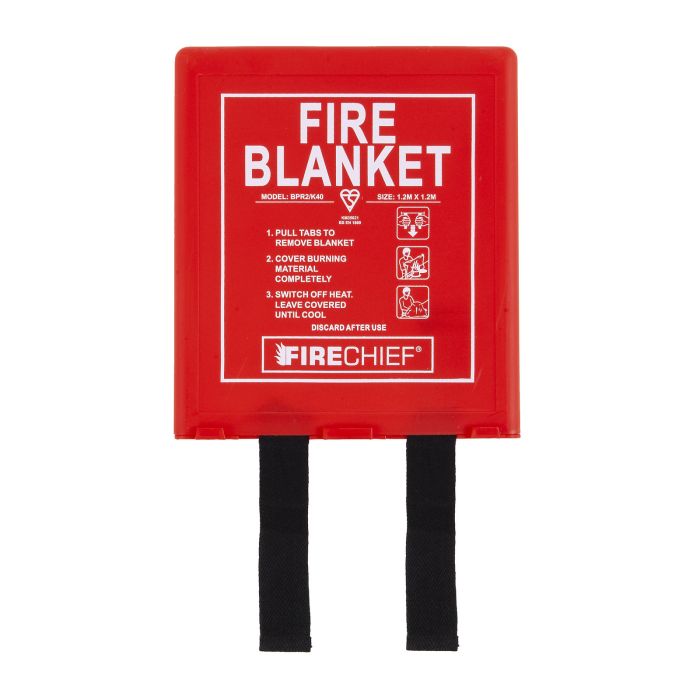
- Rigid cases protect the blanket from grease, knocks and tampering and are easier to wipe clean. Options include the Firechief BPR1/K40 1 x 1 m rigid case, the Firechief BPR2/K40 1.2 x 1.2 m rigid case, the Firechief BPR4/K40 1.8 x 1.8 m rigid case and the Commander FB02 1.2 x 1.2 m blanket in a red moulded case.
See the full range of fire blankets.
Where to mount a fire blanket
- Fit it on a wall where it is easy to reach and clearly visible, typically near the kitchen exit so the user moves towards a way out.
- Do not mount it directly above or beside the hob, where you would have to reach across the fire to get it.
- Keep the tapes unobstructed and mark the position with a sign, such as the Firechief photoluminescent fire blanket sign.
How to use a fire blanket
On a pan fire
- If it is safe to do so, turn off the heat source.
- Pull both tapes sharply downwards to release the blanket from its case.
- Hold the blanket by the top corners and fold the edges over your hands to shield them.
- Place the blanket gently over the pan, laying it away from you so the flames are pushed away from your body. Do not throw it.
- Leave the blanket in place and do not lift it to check. Fire safety advice is commonly to leave it for at least 30 minutes so the contents cool and cannot re-ignite.
- If the fire is not out, or spreads, leave the room, close the door, get everyone out and call 999.
On clothing
Stop the person from running, get them to the ground and wrap the blanket around them to smother the flames, then roll them if needed. Call 999 and get medical help for any burn.
When not to rely on a fire blanket
- Commercial deep fat fryers hold too much oil for a blanket. These need a wet chemical extinguisher.
- Larger fires, or any fire you cannot cover completely, should be left to the fire service.
- Lithium-ion battery fires behave differently. Specialist battery fire blankets, such as the Firechief LithShield Tough 1.55 x 1.55 m, are designed to slow down and isolate battery fires in electronics. Read our guide to lithium-ion battery fire safety before choosing one.
Checking and replacing
Check fire blankets as part of your routine fire safety checks: the case should be undamaged, the tapes accessible and the blanket in place. A fire blanket is single use. Once it has been used on a fire, replace it.
Frequently asked questions
What size fire blanket do I need for a kitchen?
1.2 x 1.2 m is the most popular size for home and workplace kitchens. 1.0 x 1.0 m suits small spaces such as caravans.
Can you reuse a fire blanket?
No. Replace it after it has been used on a fire.
How long should you leave a fire blanket on a pan?
Leave it in place and do not lift it to look. Common advice is at least 30 minutes, until the pan has cooled.
Do fire blankets expire?
Check the manufacturer's guidance and guarantee, and replace any blanket that is damaged, dirty or has been used.
Is a fire blanket better than an extinguisher for a chip pan?
For a small domestic pan fire, a fire blanket is often the simplest option. Never use water. Commercial fryers need a wet chemical extinguisher.
This guide is general information. Follow your fire risk assessment and the manufacturer's instructions, and never put yourself at risk.