


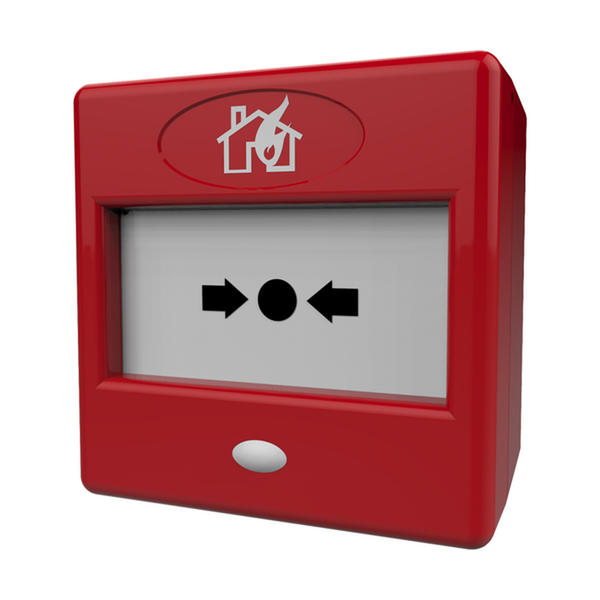

A manual call point (often called a "break glass" or fire alarm call point) lets anyone who discovers a fire raise the alarm by pressing a single element. In the UK, call points for fire alarm systems are red, certified to BS EN 54-11, and sited under BS 5839-1 on escape routes, at storey exits and at final exits, so that nobody has to travel more than 45 m to reach one. This guide covers the different types of call point, the siting and height recommendations, colours, covers and testing, so you can choose the right product for the job.
What is a manual call point?
A manual call point is a wall-mounted switch connected to the fire alarm control panel. When someone pushes the operating element, the call point changes state and the panel sounds the alarm. Every fire alarm system designed to BS 5839-1 includes call points, even where automatic detection is also fitted, because a person often discovers a fire before a detector does.
The European product standard is BS EN 54-11. Look for this certification on the product or its datasheet. For example, the Apollo SC2900-001APO conventional call point and the Apollo 55100-001APO are both certified to EN 54-11.
Type A and Type B call points
EN 54-11 defines two types:
- Type A (single action): breaking or pushing the element raises the alarm straight away.
- Type B (double action): breaking the element exposes a button that must then be pressed.
BS 5839-1 recommends Type A call points for fire alarm systems in the UK, because the alarm is raised in one simple action.
Glass or resettable element?
Older call points use a frangible glass that has to be replaced after every activation or test. Most current models use a resettable element: the flexible plastic element is pushed in and then reset with a key, so there is no glass to replace and no risk of cuts. The Apollo SC2900-001APO, for example, has a resettable element and a 170° viewable LED that shows which call point has been operated.
Conventional, addressable and outdoor call points
- Conventional call points connect to a zone circuit on a conventional panel, which tells you which zone is in alarm.
- Addressable call points have their own address on the loop, so the panel shows exactly which call point was operated. They must match the panel's protocol.
- Outdoor and weatherproof call points are needed in exposed locations. The Apollo 58200-951APO Discovery outdoor call point is EN 54-11 and EN 54-17 certified, with a built-in short-circuit isolator for XP95 and Discovery loops.
If you are still deciding on the system type, our guide to addressable vs conventional fire alarm systems explains the differences.
Where should call points be sited?
BS 5839-1 gives the main siting recommendations. Your system designer should confirm the layout for the building, but the key points are:
- Fit call points on escape routes and at every storey exit and every exit to open air, whether or not the exit is a designated fire exit.
- Nobody should have to travel more than 45 m to reach the nearest call point. This reduces to 25 m where people have limited mobility or a fire could develop quickly.
- Mount call points at about 1.4 m above finished floor level. A lower height may be appropriate where wheelchair users are likely to be the first to raise the alarm.
- Place them where they are easy to see and reach, and not hidden behind doors or furniture.
Call point colours
Fire alarm call points are red. Other colours are used for other functions, and they must not be confused with fire alarm call points:
- Green call points are used for emergency door release on access-controlled exits, such as the KAC M3A green call point with "Emergency Door Release" text.
- Yellow, blue and other colours are commonly used for functions such as extinguishant release or hold-off controls.
Protective covers and signs
In schools, busy corridors, warehouses and public areas, a hinged cover helps prevent accidental operation while keeping the call point visible. The Apollo 44251-189APO transparent hinged cover fits all Apollo-made call points. A cover must still allow the call point to be operated quickly in an emergency, so agree its use with your system designer. A "Fire alarm" sign, such as the Firechief W6421A, helps mark the position of call points.
Testing call points
BS 5839-1 recommends a weekly test of the fire alarm system from a call point, using a different call point each week so that every one is tested in rotation. Resettable call points are tested with a test key, so nothing needs replacing afterwards. Our weekly fire alarm testing guide explains the routine and the log book.
You can see the full range, including back boxes, covers, spare elements and test keys, in our manual call points collection.
Frequently asked questions
What height should a fire alarm call point be?
BS 5839-1 recommends about 1.4 m above floor level. A lower height may be justified where wheelchair users are likely to raise the alarm.
What is the maximum distance to a call point?
45 m travel distance, reduced to 25 m where occupants have limited mobility or a fire could spread rapidly.
Are break glass call points still allowed?
Yes, glass elements are still available, but resettable elements are now more common because they are easier to test and reset.
Can I use a green call point for the fire alarm?
No. Green call points are for emergency door release. Fire alarm call points are red.
Do conventional and addressable call points interchange?
No. Choose a call point that matches your panel type and, for addressable systems, the panel's protocol.
This guide is general information; system design, siting and testing should follow BS 5839-1 and the advice of a competent fire alarm designer or installer.